The Lady at Noon
Bohemia and Moravia (cognate field-belt across Slavic Europe) · Folk tradition, recorded mid-nineteenth century
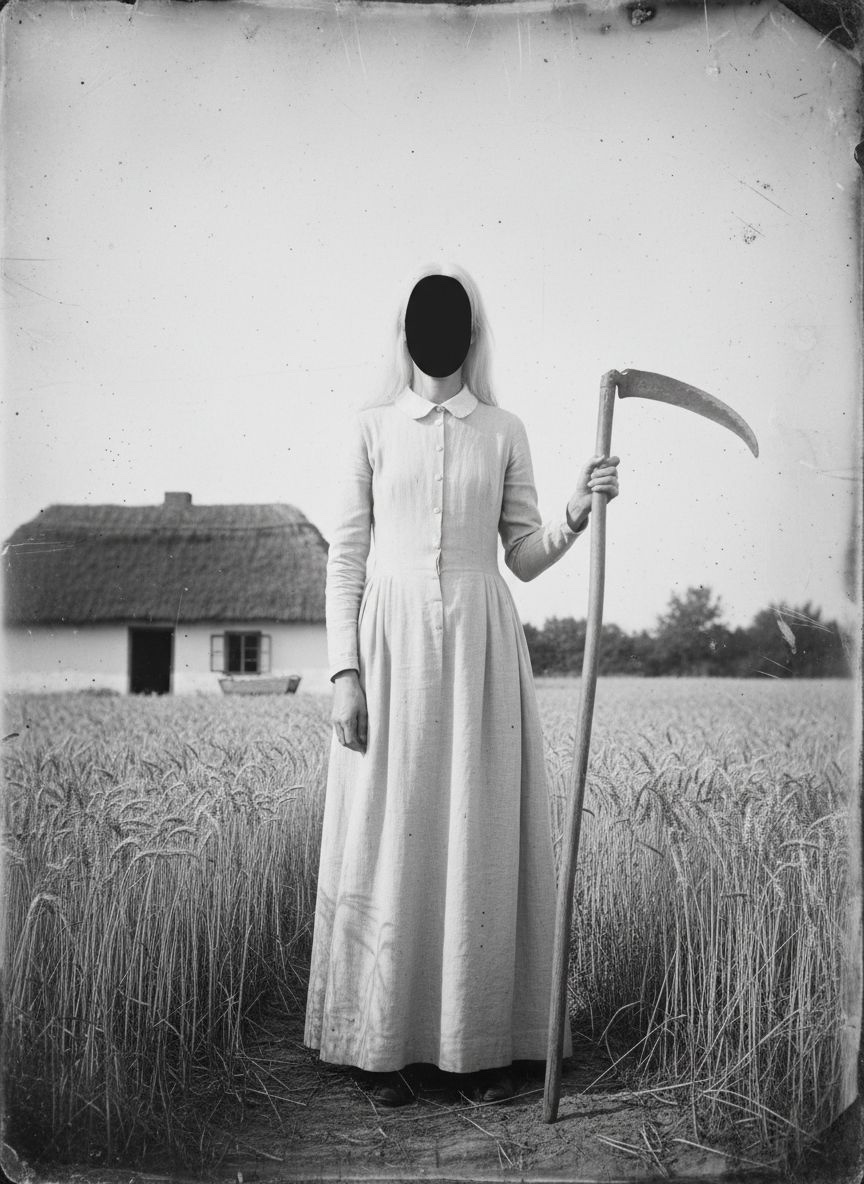
The harvest village had a procedure for the hour of noon. The procedure had not been written down by any priest of the parish, but the eldest women of the household kept it and taught it to the daughters before the daughters were old enough to work the field-margins. The procedure had three parts. The work in the field stopped a quarter-hour before the bell. The infants in the cradle were brought into the cool of the house. The windows on the south side, where the rye stood at the height of a man’s shoulder, were closed.
The procedure was for the polednice.
The Czech ethnographer Karel Jaromír Erben, who compiled the field-record across Bohemia and Moravia from the eighteen-thirties onward, recorded the figure under that name in the volumes that became, in 1853, the ballad cycle Kytice. The cognate ran east through the Slavic field-belt: the Russian poludnitsa, the Sorbian pśezpołdnica, the Polish południca. The figure walked at the noon hour of the hottest day of summer. The figure walked in the standing rye. The figure walked towards the household that had failed the procedure.
On her appearance
The descriptions, in the field-record, converge.
She was tall. The accounts are particular on the tallness: a head and a half above any man of the village, the proportion just shy of correct. The hair was white. The dress was white, of unbleached linen, of the cut the village remembered from the grandmothers and not from any living woman. In some accounts she carried a scythe of the long-handled mowing kind; in others she carried a sickle of the short-handled reaping kind; in the older accounts she carried only her own hands, the fingers held slightly apart, the palms turned outward as she walked. She walked through the standing rye without bending the stalks.
She was not heard before she was seen.
The accounts insist on the silence. The cicadas, which had filled the noon hour from dawn, stopped at the quarter before twelve. The dogs of the household, which the household had not had time to call inside, lay down and did not rise. The bell of the parish struck twelve, and on the third stroke the figure was at the edge of the rye, and on the seventh stroke she was at the door of the yard, and on the twelfth she was at the threshold of the room in which the household had failed to close the southern window.
She asked one question.
On the question
The question was not a riddle. She asked the mother, in the Polednice ballad, to tell her about the child in the cradle. She asked the labourer, in the field-cases, to name the field he was working. She asked the eldest of the household to name the dead of the family in the order of their dying. The question was small. The condition was not.
The condition was that the answer had to be completed in the time it took the cicadas to begin again.
The silence after the bell lasted between one and two minutes. The mother who could not name the child in that time, who stammered, who began to sing a lullaby instead, who lifted the child and held it to the chest in the hope that the lifting would stand in for the answer, was the mother who, in the ballad, found that her arms, when the cicadas had at last resumed, were closed too tight around what they held.
The Erben ballad records the case of one such mother. She had been working at the loom. The child had cried. She had hushed the child sharply, and had told the child that if the crying did not stop the noon woman would come. The child had not stopped. The noon woman had come. The mother, in panic, had pressed the child to her breast and had held the child there past the time the cicadas had resumed. The husband, returning from the field at the meal hour, had taken the child from her arms. The child had been dead for some minutes by then.
On the procedure of the household
The procedure, in the villages where it was kept, was strict.
The implements were laid down. The reapers and the binders moved to the field-margin and did not speak above a low voice between the quarter and the half-hour. The infants were brought into the cool of the house and laid in the cradle in the room furthest from the south window. The household did not, in the half-hour after noon, call any person by their full name aloud, on the understanding that the figure walking in the rye might mistake the calling for an invitation.
The figure, in the villages where the procedure was kept, was not seen.
The figure, in the villages where the procedure had been forgotten, was seen often enough that the noon hour, in the harvest months, was the hour the parish doctors of the nineteenth century recorded as the hour of the strange deaths of children and of the strange faintings of mothers at the loom.
The archive holds no position on whether the tall woman of the white linen walked from the rye at the third stroke of the parish bell. The archive observes only that the cicadas stopped at the quarter before twelve, that the villages of Bohemia and Moravia laid down their tools at that quarter and not the next, that the southern windows were closed in the heat against the practical good of the household, and that the Polednice ballad, when it was published in 1853, was sung from memory in the parishes from which Erben had taken it.
- Erben, Karel Jaromír. *Kytice z pověstí národních*. Prague: Pospíšil, 1853. The collected Czech ballad cycle including the *Polednice* poem, drawn from the field-record Erben compiled across Bohemia and Moravia from 1834 onward.
- Máchal, Jan. *Nákres slovanského bájesloví*. Prague: Bursík + Kohout, 1891. The first comparative survey of Slavic mythology, treating the *polednice* in its pan-Slavic context (cognate Russian *poludnitsa*, Sorbian *pśezpołdnica*, Polish *południca*).
- Grohmann, Josef Virgil. *Aberglauben und Gebräuche aus Böhmen und Mähren*. Prague and Leipzig: Calve, 1864. The standard nineteenth-century compendium of Bohemian and Moravian folk belief, with the noon-hour demon entries in section IV.