The Pishtaco of Ayacucho
Peru (the Andean highlands, Ayacucho department) · Modern, the panic of December 1987
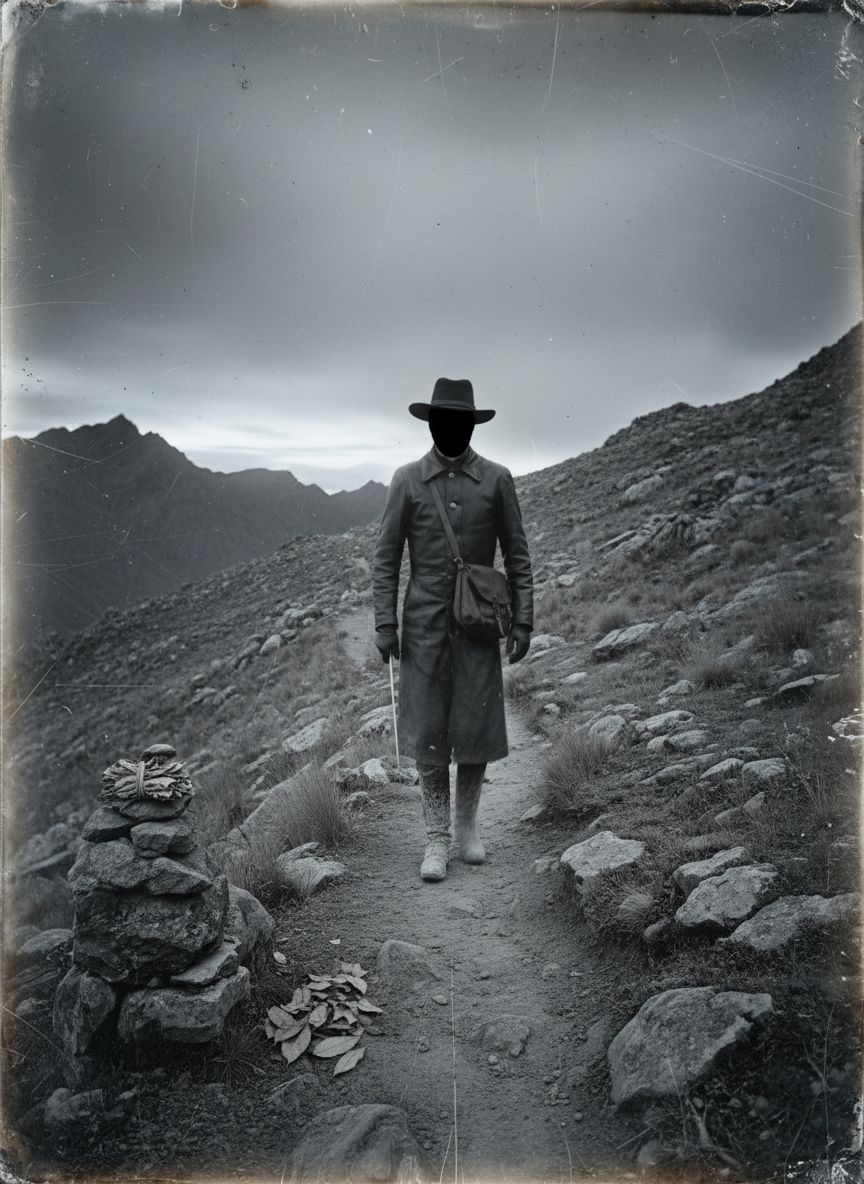
The figure was old in the highlands before it had a name in any record. The pishtaco, in the Quechua, was the cutter. The figure was a stranger, was tall, was pale of skin and light of eye. He came down the mountain trail at dusk. He carried a long knife, and a small bottle of a fine grey dust, and a satchel into which he put what he took.
What he took was the fat.
The accounts agree on the procedure. He sprayed the dust from the bottle into the face of the traveller, and the traveller slept, and the figure opened the body at the ribs and at the small of the back with the long knife. He lifted the white grease from the cavity in handfuls. He closed the body, by some method the accounts do not describe, so that the wound was not seen. He left the body upon the trail. The corpse, afterwards, did not sink. The water in the highland lakes is cold and old. The corpse rose to the surface and would not go down.
The figure was reported in the chronicles of the sixteenth century, named there a nakaq, a slaughterer. The figure was reported, in the same form, in every century thereafter. The figure was reported, with the same procedure, in December of 1987.
On the panic
The panic began in the highland villages of Ayacucho department in the second week of December.
The reports were these: that under pressure of the foreign debt, the central government in Lima had contracted with foreign agents for the supply of human fat in industrial quantities, and that the agents had loosed, into the highlands, some five thousand pishtacos to gather it at scale. The fat was said to be flown out of the country by helicopter from the high passes, required for the lubrication of machines the foreign creditors had built and could not run without it.
The reports moved through the villages by the route on which the highland reports always moved: by the markets, by the chapels, by the trucks that came down from the high puna with potatoes. The reports were not consistent in their figures. They were consistent in their structure. A stranger had been seen on the trail. The stranger had been tall, had been pale, had worn a long leather coat against the cold, had carried the long knife. The stranger had not been a local man.
The villages began to watch the trails after dusk.
On the traveller
In the third week of December, in a village the reports name variously as Huanta or Vilcashuamán, a traveller came down a trail at the close of the day. He was a man of the next valley. He had business in the village. He was tall, the reports say, and his coat was long, and his hair was lighter than the hair of the local men, and he was a stranger to the village though not, in the larger sense, a foreigner.
He was met at the entry to the village by a group of men.
The reports do not agree on what was said. The reports agree on the outcome. The man was beaten with stones. He was beaten in the road in the sight of women and children. He was beaten past the point at which a body recovers. He died, the reports say, before the dusk had fully gone.
The body was searched. There was no knife. There was no bottle. There was no satchel. There was, in the satchel he did carry, only papers of his trade, and a small loaf of bread, and a letter to a brother in the next valley which he had not yet sent.
The body was buried by the village in the cemetery of the village. The grave was unmarked. The grave was at the perimeter of the consecrated ground, on the ground reserved for those whose status the village could not, at the hour of the burial, determine.
On what the records preserved
The ethnographic record of the figure has continued without interruption from the colonial chronicles to the present. The figure has appeared in court records of the nineteenth century, in oral history transcripts of the mid-twentieth, in the reports of medical anthropologists who, in the 1980s, attempted to trace the figure to specific anxieties around blood-bank collection by foreign aid organisations operating in the highland communities.
The 1987 panic produced, in addition to the death at the village, several other beatings and a brief debate in the Lima press as to whether the army’s counter-insurgency presence in the department had contributed to the climate in which the panic took hold. The debate was not resolved. The department remained, through the close of the decade, a place in which a stranger arriving at dusk would not take the lower trail.
The archive holds no position on whether the pishtaco walked the trails of Ayacucho in December of 1987. The archive observes only that a traveller of the next valley was beaten to death by villagers on his way to deliver a letter to his brother, and that the letter was not delivered, and that the figure the village had taken him for had walked, in the records, since the sixteenth century, and had not, in any of those centuries, been positively identified.
- Weismantel, Mary. *Cholas and Pishtacos: Stories of Race and Sex in the Andes*. Chicago: University of Chicago Press, 2001. The book-length study of the figure across four centuries of Andean record, chapters five and six addressing the 1987 panic directly.
- Oliver-Smith, Anthony. "The Pishtaco: Institutionalized Fear in Highland Peru." *Journal of American Folklore* 82, no. 326 (1969): 363-368. The earliest ethnographic article in English, establishing the figure as continuous from colonial through modern record.