Popobawa at Pemba
Tanzania (Pemba Island, Mkoani; the Zanzibar archipelago) · Modern, the panic of Ramadan 1995
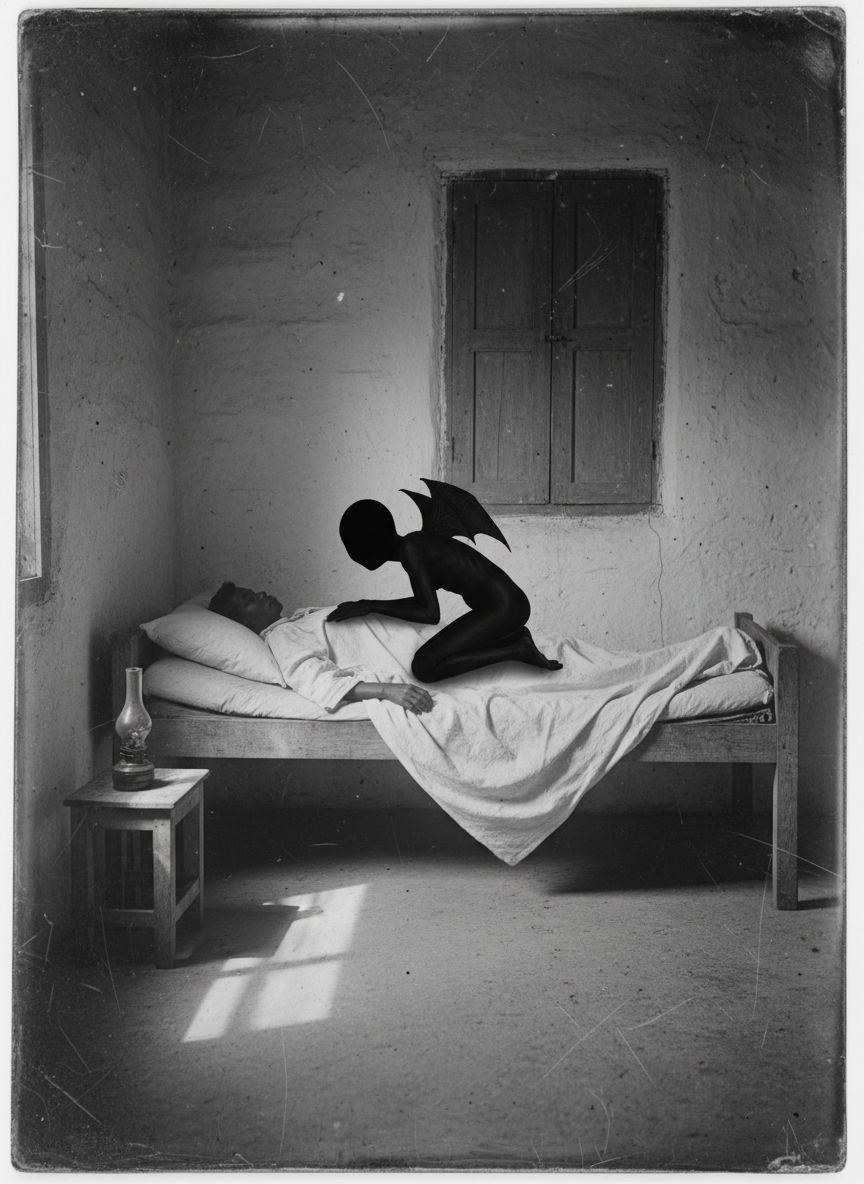
The first reports came from Mkoani, on the southern coast of Pemba Island, in the second week of Ramadan in 1995. The reports were of a single phenomenon, repeated in household after household, in the small hours of the night.
A sleeper would wake.
The sleeper would find that he or she could not move. The chest was held under a weight. The weight had the shape of a body. The figure could not be seen clearly in the dark of the room, but the figure could be felt: the arms across the chest, the breath at the ear, the smell of something the witnesses described as burning or scorched. The figure pressed down. The figure spoke.
The figure gave one instruction. The instruction was to be repeated at dawn to the neighbours, in plain words, in the open. If the instruction was followed, the figure would not return. If the instruction was not followed, the figure would return the next night, and the next night would be worse.
The figure was called Popobawa. The bat-wing.
The reports moved from Mkoani to the smaller villages of the south of Pemba in the course of three nights. By the fourth night the reports had reached the channel. By the second week the reports had crossed to Unguja, the larger island, and were being recorded in households of Zanzibar Town.
On the response of the villages
The response was the response of any island community at the limit of its sleep.
The men of the villages, in numbers, began to keep the nights out of doors. The lamps were carried out and set in lines along the walls of the houses. The Qur’an was read aloud, in groups, in the open ground at the centre of each village. The women and the children slept in clusters in the inner rooms with the doors held shut. The figure was reported, in the accounts of these nights, as standing at the perimeter of the lamplight and not crossing.
The Friday sermons of the second and third weeks of Ramadan addressed the figure in plain language. The clerics reminded the congregations of the duty of the report at dawn, and that the recourse of the believer, under the figure’s pressure, was prayer and the public report.
The figure continued.
The press of Dar es Salaam picked up the story by the close of the second week. The press of Nairobi followed. By the third week the figure was being reported in articles published in London. The articles emphasised the strange specificity of the figure’s demand: not the taking of blood, not the taking of breath, not the taking of a name. The figure required that the attack be made known. The figure required the village to speak.
On the third of April
In the last week of the month, the panic on Unguja produced its first confirmed fatality.
The fatality was a man of the mainland. He had come to Zanzibar Town on the business of a small trade. He spoke Swahili of a mainland accent. He had taken a room at a guest house near the harbour. He was, on the night of the third of April, in the street near the guest house at a late hour, having come out for tea.
He was met in the street by a number of men.
The reports do not agree on what was said. They agree on the outcome. The man was beaten with sticks and with stones, past the point at which a body recovers. He died before the early prayer. The mainland press, in the days following, identified him by his trade and by the name of his brother in the city of origin. The police entered the case. The investigation produced no convictions. The figure had not, the witnesses said, been the man. The figure had been the figure. The man had only stood in for what the witnesses had been unable to confront in the figure.
Two other beatings on Unguja, in the same week, did not produce fatalities. The men were released by the crowds before the worst could be done.
On the close of the panic
The panic closed with the close of Ramadan.
The reports from the villages thinned in the last days of the fast. The lamps were brought back into the houses. The men returned to sleep in the inner rooms. The figure is recorded in Zanzibar in earlier panics of 1965, 1970, and 1971, and in further panics in the early twenty-first century. The pattern, in each instance, has been the same. The press at dusk. The instruction at the ear. The requirement that the village speak.
The archive holds no position on whether the bat-wing has walked the lanes of Mkoani in any given Ramadan. The archive observes only that a panic was reported in a particular month of a particular year, and that the panic produced a death in the street of a port town in the last week of the fast, and that the man who died had come to the island on the business of a small trade, and that the brother in the city of origin received the body in the week following.
- Walsh, Martin T. "The Politicisation of Popobawa: Changing Explanations of a Collective Panic in Zanzibar." *Journal of Humanities*, Mzumbe University, Tanzania, 2009. The field-grounded analysis of the 1995 Ramadan panic and its political readings, drawing on direct interviews with Mkoani and Zanzibar Town informants.
- Parkin, David, and Martin Walsh, editors. *Killing Popobawa: A Zanzibari Spirit and Its Critics*. London: Sean Kingston Publishing, 2014. The collected ethnographic record of the figure across the late twentieth century, including the mob killings of 1995.