The Most Haunted House in England
England, Essex (Borley, near the Suffolk border) · 1863 to 1939, with the principal investigation 1929 to 1938
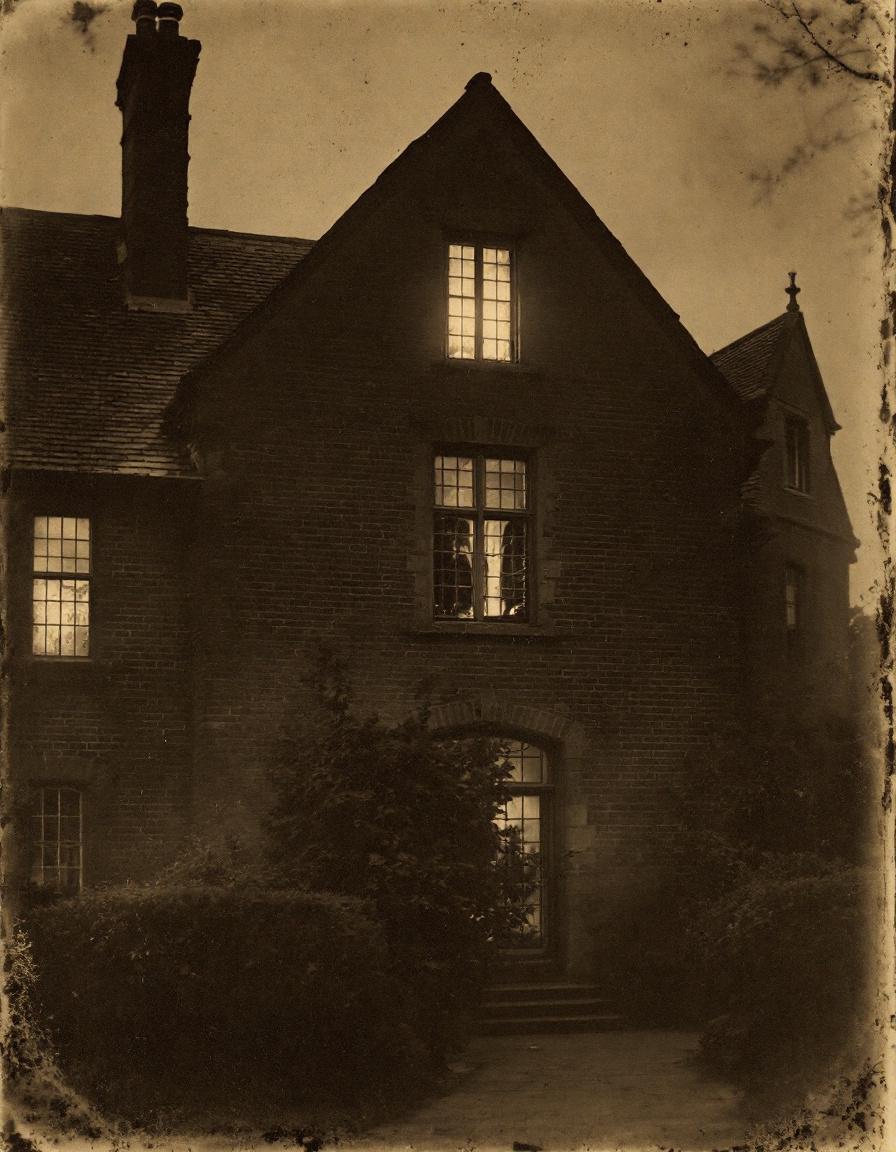
The rectory stood in the parish of Borley, in Essex, near the Suffolk border, on a slight rise above the river. It had been built in 1863 for the Reverend Henry Bull. The Reverend Bull was a hunting man and the father of fourteen children, and the rectory he built had been built large to accommodate them, and the rectory, by the time of the events the records preserve, had been added to in red brick on three further occasions.
The first reports come from the Bull household, in the closing decades of the nineteenth century. A nun was seen, several times, walking the path that ran along the lawn at the back of the property. The path came to be called the Nun’s Walk. The accounts of the Bull daughters, given as adults to interviewers, agree on the figure: a woman in dark habit, head bowed, walking a fixed line and not turning. The figure was seen in daylight. The figure was seen, on one occasion, by four of the daughters at once.
The reports continued under the Smith household, who occupied the rectory briefly in the late 1920s, and intensified under the Foyster household, who took it in 1930. The Reverend Lionel Foyster’s wife, Marianne, was at the centre of the Foyster-period reports. Objects were thrown. Writing appeared on the walls. The writing, in pencil, was directed to her by name. Marianne. Please help. Get light. Mass. Prayers. The records preserve photographs of the writing. The records do not, in the modern survey, agree that the writing was made by the agency it claimed.
On the apparatus
Harry Price was a paranormal investigator of the period. He was, by training, a journalist; by trade, a researcher; by temperament, the records agree, a showman. He had been associated with the Society for Psychical Research, though his relations with the Society were not always good. He had built and equipped, in London, a National Laboratory of Psychical Research. He brought the laboratory’s methods to Borley.
The methods were instrumented. Price brought thermometers. He brought brass field meters. He brought cameras, fitted with magnesium flash, set on tripods at the corners of the rooms in which the disturbances were said to occur. He brought a sealing wax for the doors and a powder for the floors, the better to record the passage of footsteps that ought not to have crossed them. He recruited observers. He kept watch logs. He published the records.
The published records are voluminous. The Most Haunted House in England, in 1940, runs to four hundred pages. The End of Borley Rectory, in 1946, follows the case through the rectory’s destruction by fire in 1939 and its demolition in 1944. The records describe footsteps, knockings, displaced objects, the bell-pulls of the kitchen wing ringing on their own, the wires above them found cut for years. The records describe the apparition of the nun, repeatedly, by named witnesses, in conditions Price had attempted to control.
It is recorded that the bell-pulls rang. The wires above them, when checked, had been cut for years. The witnesses to the ringing included, on at least three occasions, men of standing whom Price had brought down from London for that purpose.
On the contested record
The Society for Psychical Research, after Price’s death, undertook a critical survey of the case. The survey was published in 1956 as The Haunting of Borley Rectory. Its authors were Dingwall, Goldney, and Hall. They had access, after Price’s death, to the materials Price had not published, and to correspondence with witnesses who had not been quoted in the books, and to the recollections of Marianne Foyster, who had by then withdrawn from the case for many years.
The 1956 report concluded, in measured language, that some portion of the phenomena had been produced by living agency. The wall-writing, in particular, was attributed to Marianne Foyster. The bell-ringing was attributed in part to Price himself, who was seen, by one witness, palming small stones near the wires. Other phenomena, the report acknowledged, did not admit of straightforward explanation. The nun on the lawn, in particular, the report set aside, neither confirming nor dismissing.
The archive holds no position on whether the nun walked. The archive observes only that she was seen, by named witnesses, over a span of seventy years, on the same path, walking in the same direction, and that the path is no longer there, and that the rectory is no longer there, and that the records remain.
It is recorded, in the End of Borley and in the SPR survey both, that on the night the rectory burned, the figure of a woman was seen in the upper window of the east wing, looking out, and that the wing in which she was seen had been empty since the Foyster departure, and that the figure did not move while it was watched.
- Price, Harry. The Most Haunted House in England: Ten Years' Investigation of Borley Rectory. London: Longmans, Green and Co., 1940.
- Price, Harry. The End of Borley Rectory. London: Harrap, 1946.
- Dingwall, E. J., Goldney, K. M., and Hall, T. H. The Haunting of Borley Rectory: A Critical Survey. Proceedings of the Society for Psychical Research, Volume 51, 1956. The post-mortem investigation.