Arnold Paole
Serbia (the village of Medveđa, Trstenik district, West Morava) · Early modern, the winter of 1731 to 1732
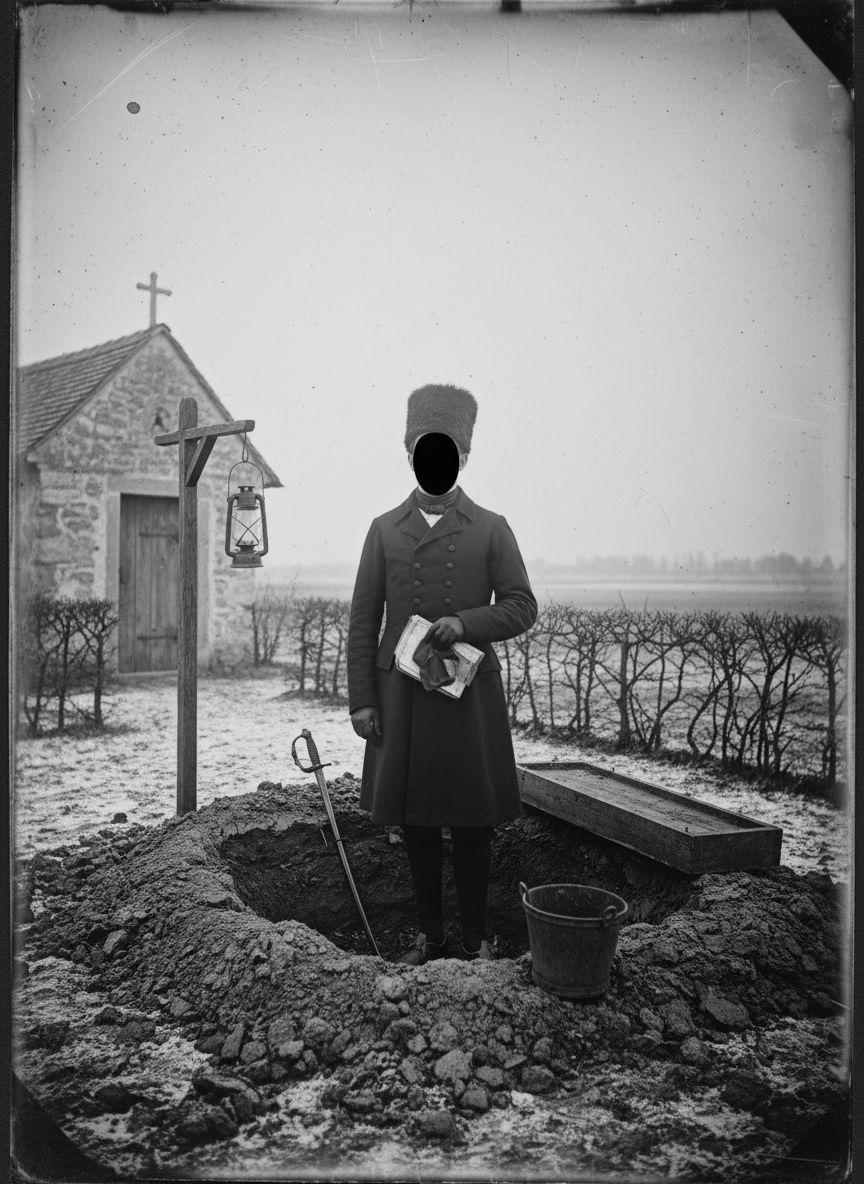
The hajduk Arnold Paole had not been a man of standing. He had served in the Imperial frontier levies. He had returned to Medveđa some years before. He had told his neighbours, in the long winter evenings before the harvest of 1727, that he had been troubled in the Levant by a thing that walked at night, that he had eaten of its grave-earth and smeared himself with its blood as the country there required, and that he had not been troubled since. He died in the autumn of that year. He fell from a hay-wagon and broke his neck. He was buried in the proper manner in the village cemetery.
Within thirty days the village reported him.
The reports were specific. Four of his neighbours died in a single fortnight, each within hours of one another, each having complained the night before of a weight upon the chest and of a face at the window. The villagers opened the grave. The body, the village headmen wrote in the petition that travelled north to the Habsburg garrison at Belgrade, was as it had been laid down, the skin of the face fresh, the nails grown new at the bed of the old, fresh blood at the corners of the mouth and at the openings of the body. They drove a hawthorn stake through the chest. The corpse groaned. The villagers afterwards burned the body to ash and scattered the ash into the Morava.
Five years passed.
In the winter of 1731 the villagers reported again. The new deaths were of cattle and of children. The village now said that Paole had fed not only upon his neighbours but upon the cows of the parish, that those who had eaten the meat had taken the contagion in turn, and that the contagion was travelling through the second generation. The Imperial command at Belgrade, uneasy at the second petition, dispatched a commission. The senior officer was the regimental surgeon Johannes Flückinger of the Fürstenbusch infantry.
On the rite the village asked of the surgeon
The commission arrived on the seventh of January.
Flückinger conducted the disinterments by day, in the open, in the presence of the village priest, of two officers of the Hereville regiment, and of two regimental surgeons attached to his command. He opened seventeen graves. He recorded the contents of each in the schedule that would form the body of his report.
Of the seventeen, five were found in the state the village had said could not be. The schedule records the bodies as vollkommen unverwesen: the skin renewed, the chest cavity holding frisches Blut in quantity, the organs intact and supple, the nails new. The remaining twelve were found in conditions consistent with the season and the depth of burial. Flückinger noted the variations without comment.
He attended the case of the woman called Stanoika with particular care. She had been buried eighteen days. The schedule records that she was lifted from the ground without difficulty, that the cloth in which she had been wrapped had not slackened, that fresh blood ran from her nostrils when the lid of the coffin was raised, and that beneath her right ear, the length of a man’s finger, ran a bruise the colour of new ink. The village said the bruise was where Paole had taken her.
The surgeon set the date and continued to the next.
On the burnings
The five bodies were treated in the manner the village required.
The breast of each was opened with a regimental sabre and the heart drawn out. The hearts were set upon a pyre of beech and elder gathered the day before by the haiduk auxiliaries. The remaining flesh was struck through with hawthorn and the four bodies of the contagion-line were placed upon the same fire. Flückinger recorded the order of the burnings, the duration of each, and the disposition of the ash. The ash was carried in two iron pails to the bank of the Morava and emptied into the current. The village priest read from the book of the burial as the pails were emptied. The wind, the surgeon wrote, was from the east.
The commission departed Medveđa on the twenty-sixth of January. Flückinger and three fellow officers signed the report at Belgrade on the same day. The report was forwarded under seal to the Imperial War Council at Vienna and from there, within the year, to the newspapers of Leipzig, Nuremberg, and London.
On the surgeon
Flückinger was a man of the regiments and of the new medicine. He had not gone to Medveđa to find a revenant. He had gone to certify the state of the bodies in a parish under Habsburg authority. He wrote the report in the dry German of the regimental scribe. He proposed no theory of the cause. He recorded the village’s testimony as testimony and the condition of the corpses as condition. He did not say the dead had risen. He did not say they had not.
The archive holds no position on whether the hajduk returned to Medveđa in the winters of 1727 and 1731. The archive observes only that the village petitioned twice, that the Imperial command sent a surgeon, that the surgeon opened seventeen graves, that he wrote down the bruise the length of a finger beneath the right ear of the eighteen-day-buried Stanoika, that the bodies were burned, and that the report, once it reached Leipzig in the spring, was reprinted in twelve cities before the year was out.
- Flückinger, Johannes. *Visum et Repertum*. Belgrade, January 1732. The Imperial Austrian regimental surgeon's report on the Medveđa disinterments, signed by Flückinger and three fellow officers of the Hereville and Fürstenbusch regiments. Reprinted in Klaus Hamberger 1992 *Mortuus non mordet*.
- Barber, Paul. *Vampires, Burial, and Death: Folklore and Reality*. New Haven: Yale University Press, 1988. Chapter 1 treats the Paole and Plogojowitz reports as primary forensic documents.
- Hamberger, Klaus. *Mortuus non mordet: Dokumente zum Vampirismus 1689-1791*. Vienna: Turia + Kant, 1992. The collected German and Latin originals of the eighteenth-century Habsburg vampire dossiers.