The Red Mother
Pan-Turkic (Anatolia, Azerbaijan, the Volga-Kama, the Kazakh steppe) · Folk tradition, recorded nineteenth and twentieth centuries
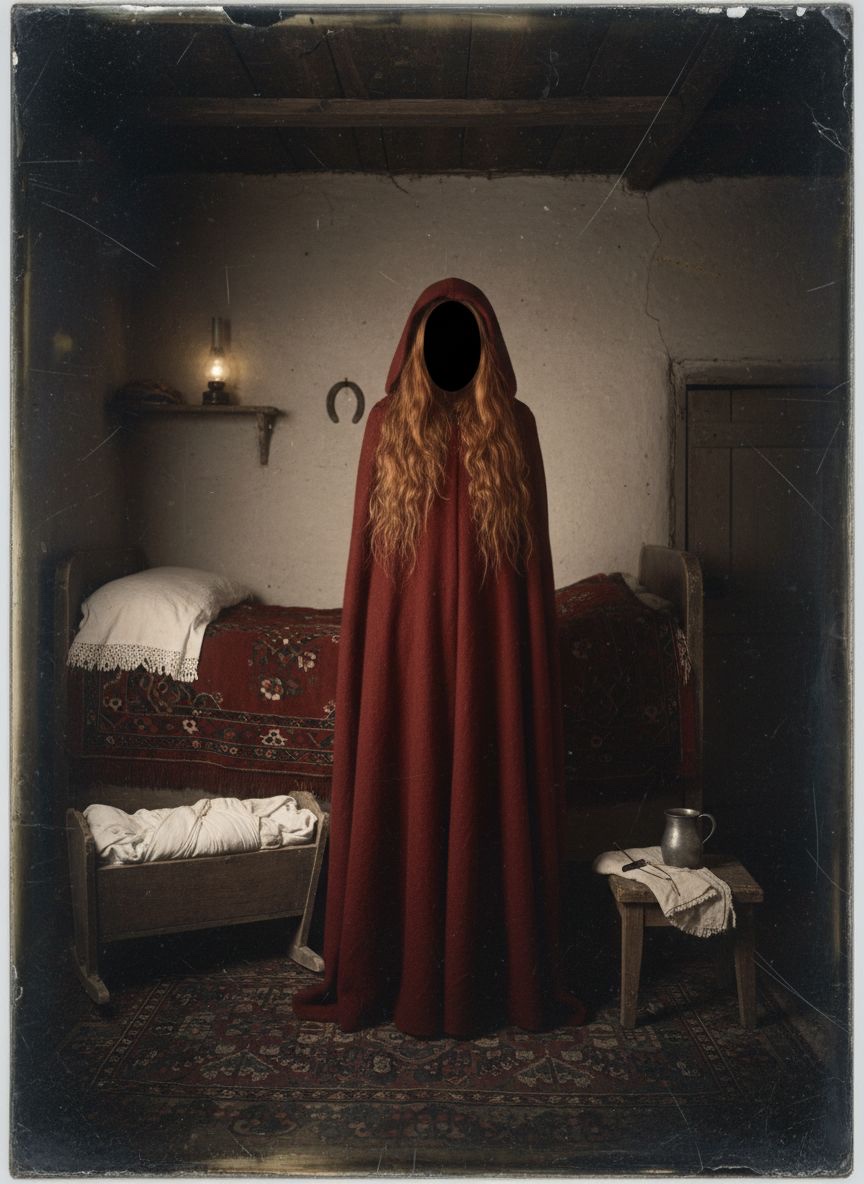
The case is not a single case. It is the same case as it was recorded in Anatolian villages, in Azerbaijani river country, in Tatar settlements of the Volga and the Kama, and on the Kazakh steppe. The name varies. Albastı in the Anatolian, al-karısı in the Tatar, almasty in the Caucasus. The structure is constant. The records collected by İnan and by Basilov agree on what happened in the lying-in room.
The window was the forty-day count.
The records are exact on this. A woman who has given birth is at risk for forty days. The first night is dangerous; the seventh more so; the fortieth the last on which the albastı may still come. After forty days the door of the lying-in room may be opened. Before forty days it is kept shut, the iron at the threshold, the woman not left alone, the lamp not extinguished.
The records describe what happened when the lamp went out.
On the thing on the bed
She came in red.
The accounts that Basilov gathered in the Fergana valley and that İnan recorded in central Anatolia describe the albastı in the same colour. Her hair was the colour of new copper, or of dried blood, or of the inside of a freshly cut liver. The skin was pale. She was tall. The constant was the breasts. They were long. They were not the breasts of a nursing woman. They were hung over her shoulders, the records say, like the saddlebags of a courier, one to the front and one to the back, so that she could move on all fours without dragging them.
She did not enter through the door. She entered through whatever the door was not closing.
She climbed onto the lying-in bed.
The records emphasise the weight. There was no weight. The mother, half-asleep, did not feel the mattress shift. The first thing she felt was the cold hand at her jaw, opening her mouth. The hand reached past the teeth, into the throat, and down. The albastı drew the liver out whole. It came up through the throat with a sound the records compare to the drawing of a cork from a wet bottle. The mother, throughout, was unable to scream.
The albastı turned and ran for the door.
On the run to the river
She had to reach the water. If she reached the water the mother was dead.
The accounts Basilov collected in the Kazakh steppe villages are specific on the geography of the rite. The albastı could not consume the liver inland. It had to be carried, whole, in the demon’s hand, across whatever distance separated the house from the nearest running water. At the bank, she would wash it, would eat, would vanish. The death of the mother was the moment the liver entered the river. If the albastı could be intercepted before the water, the liver could be returned. The mother could live.
The interception was the work of the husband, or of the elder women, or of the otacı called for the forty days.
The chase was silent. The albastı moved on all fours, the breasts swinging, the hair trailing wet behind her. She did not look back. She was visible only to the watcher who had been chosen to see her. In some accounts only the otacı could see her at all, and the husband ran behind him, holding the lamp, seeing only the otacı running through the dark fields toward the riverbank.
The chase ended at the iron.
On the iron rite
The otacı carried an iron needle.
The needle was a saddler’s needle, blunt at the tip but heavy, the kind a man could drive through a horsehide. The otacı caught the albastı before the water. He pinned her by the hair. He drove the needle through her breast. The needle did not kill her. The albastı could not be killed by iron, by fire, by anything in the world of the village. The iron only pinned her.
The pinning was permanent so long as the iron remained.
She became, by the records, a servant of the family. So long as the needle stayed in her breast, she was bound. She fetched water. She kneaded bread. She did not speak. Basilov recorded households in the Volga-Kama where an albastı had been kept in service for two generations. The needle could not be removed by any hand but the otacı’s. If it was drawn out, the albastı would return, in one night, to whatever river had been her destination, and would take the liver of every woman in the house who had ever given birth.
The records add that no household ever drew the needle by choice. The needle was drawn, in every recorded instance, by a child. The child had not been told.
The archive holds no position on whether the albastı survives the pinning, or whether the iron only suspends what it cannot end. The archive observes only that the breasts were hung over the shoulders, and that the run was always to the water, and that the needle, in the households where it was driven, was driven by the otacı into the same place every time, and that the place was not written down.
- Basilov, Vladimir Nikolaevich. Shamanstvo u narodov Srednei Azii i Kazakhstana. Moscow: Nauka, 1992. The standard Soviet ethnographic survey of *albastı* across the Turkic belt, with regional variants and counter-rites.
- İnan, Abdülkadir. Tarihte ve Bugün Şamanizm: Materyaller ve Araştırmalar. Ankara: Türk Tarih Kurumu Basımevi, 1954. The Anatolian and Volga-Tatar record of the *albastı* and the iron-needle rite.