The Bouda of Tigray
Ethiopia (Tigray, the household of Ras Welde Selassie) · Early nineteenth century, the years 1810 to 1819
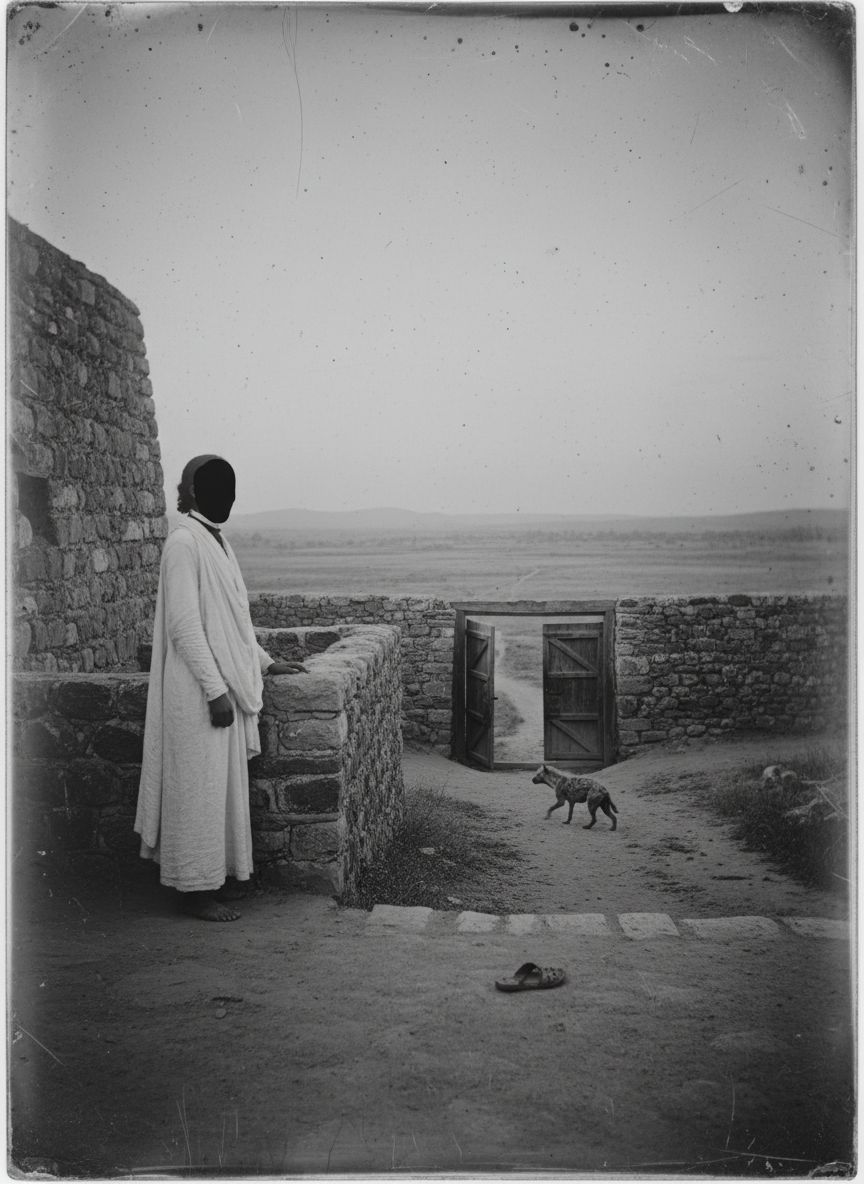
The Englishman was Nathaniel Pearce. He had taken service in 1810 with Ras Welde Selassie of Tigray and remained in the household for nine years. He kept a journal throughout, edited and published in London in 1831 by J.J. Halls after Pearce’s death in Egypt.
The journal records the politics of the highland court, the wars of the region, the customs of the household, and the matters Pearce considered worth setting down. Among them were the buda.
The buda, in the Tigrinya, was a person of a hereditary line, by tradition the line of the blacksmiths, held by the wider population to possess a faculty the population did not. The faculty was the faculty of changing form.
Pearce was, on arrival, sceptical. By the close of his service he had recorded the matter at length.
On the servant at the gate
The entry that bears most directly on the question is placed in the second volume. The servant in question was a man of the kitchen, longer in the household than Pearce. He had eaten with Pearce that morning at the side table set out in the courtyard for the men who took the early meal together.
The hour was the close of the day. The sun was at the western ridge. The household was at the inner meal. Pearce had stepped out of the dining hall onto the upper terrace of the compound to take the air.
He saw, in the lower courtyard, the servant walking toward the gate.
The servant walked, at first, in the usual manner. He passed the inner gate. He passed the outer gate. He stepped onto the path that led down the slope to the open plain. At the third step the servant dropped forward, onto his hands and feet together. The descent was, Pearce wrote, smooth, of a single motion, not the falling of a man.
The form on the path was no longer the form of a man. The forelimbs were the forelimbs of a hyena. The head was the head of a hyena. The fur, in the failing light, was the fur of a hyena. The pace, as the form moved out across the plain, was the lope of a hyena, low and rocking, the rear quarters lower than the front.
Pearce wrote that he stood on the terrace and watched the form move out across the plain until it had passed the limit of the light. Other men of the household, on the lower terrace, had seen what he had seen. The matter was not raised at the table that night.
On the morning
The morning report is recorded as a second entry.
The servant walked, at the first light, through the outer gate. He was in his own form. He was unmarked. He took up his duties at the kitchen as he had taken them up the morning before. The men and women of the household did not address him on the matter.
Pearce, in the course of the day, found occasion to walk in the courtyard with the servant and raised the matter directly. The servant did not deny it. He said, in plain words, that he was buda, that his father and grandfather had been buda, and that the faculty was not a faculty he had asked for and was not a faculty he could refuse. He said that he would not, by any voluntary action, harm a member of the household, and that the household had known him and had not had occasion to fear him. He could not speak for what other buda of the province might do.
He asked Pearce not to write of the matter in any letter that left the household. Pearce wrote of it, after the servant’s death, in the journal.
On what the road kept
The journal records further attendant matters. The carcasses of hyenas were found around the highland towns with the marks of human handling: a woman’s gold earring threaded through one tufted ear, a bracelet at one foreleg, a length of household cord at the throat. The hut of the woman, in such cases, was found empty. The cattle were unmilked. The fire of the inner room had not been relit.
The carcass was buried by the men of the next village under the rite the church of the province set out. The earring, in some cases, was returned by the priest to the household. In others it was buried with the carcass and the household was instructed not to ask after it.
Parkyns, returning a generation later, recorded the same tradition in the same form, and recorded that the people he questioned had not changed the substance of what they said. The buda were the buda. The line was known. The faculty was inherited.
The archive holds no position on the faculty Nathaniel Pearce reported from a terrace of a Tigrayan compound in the second decade of the nineteenth century. The archive observes only that Pearce wrote it down in his own hand, that an editor in London printed it without alteration, that a second Englishman of a different generation recorded the same tradition in the same province, and that the gold earring, when it appeared in the tuft of an ear by the side of a highland road, was the earring of a woman known to the next village.
- Pearce, Nathaniel. *The Life and Adventures of Nathaniel Pearce, Written by Himself, During a Residence in Abyssinia, from the Years 1810 to 1819*. Edited by J.J. Halls. London: Henry Colburn and Richard Bentley, 1831. Two volumes. The eyewitness account of a decade spent in the household of Ras Welde Selassie, including the named *buda* incidents.
- Parkyns, Mansfield. *Life in Abyssinia: Being Notes Collected During Three Years' Residence and Travels in That Country*. London: John Murray, 1853. Two volumes. The mid-century corroboration of the *buda* tradition in the same highland province, with further reports of the hyena-form attribution.