Aisha Qandisha
Morocco (the Zerhoun massif, the shrine of Sidi Ali ben Hamdouch, Meknes) · Folk tradition, recorded by Westermarck and Crapanzano
The case is the case of Tuhami. He was an illiterate tilemaker of the medina of Meknes. He was recorded across a sequence of meetings in the early 1970s by the anthropologist Vincent Crapanzano. The first encounter Tuhami described had taken place when he was a young man washing at a river on the outskirts of the city. The shrine that governed his condition stood twenty kilometres to the north, at the foot of the Zerhoun massif, in the village of Sidi Ali. The brotherhood that treated him was the Hamadsha.
The thing he had married was Aisha Qandisha.
On the woman in the cane
He had heard her sing.
The voice came from the cane that grew thick along the bank. The accounts that Westermarck collected fifty years before Crapanzano agree on the pattern of the first encounter. The voice is always a woman’s. The song is always one the man recognises and cannot place. He looks up. He does not look away.
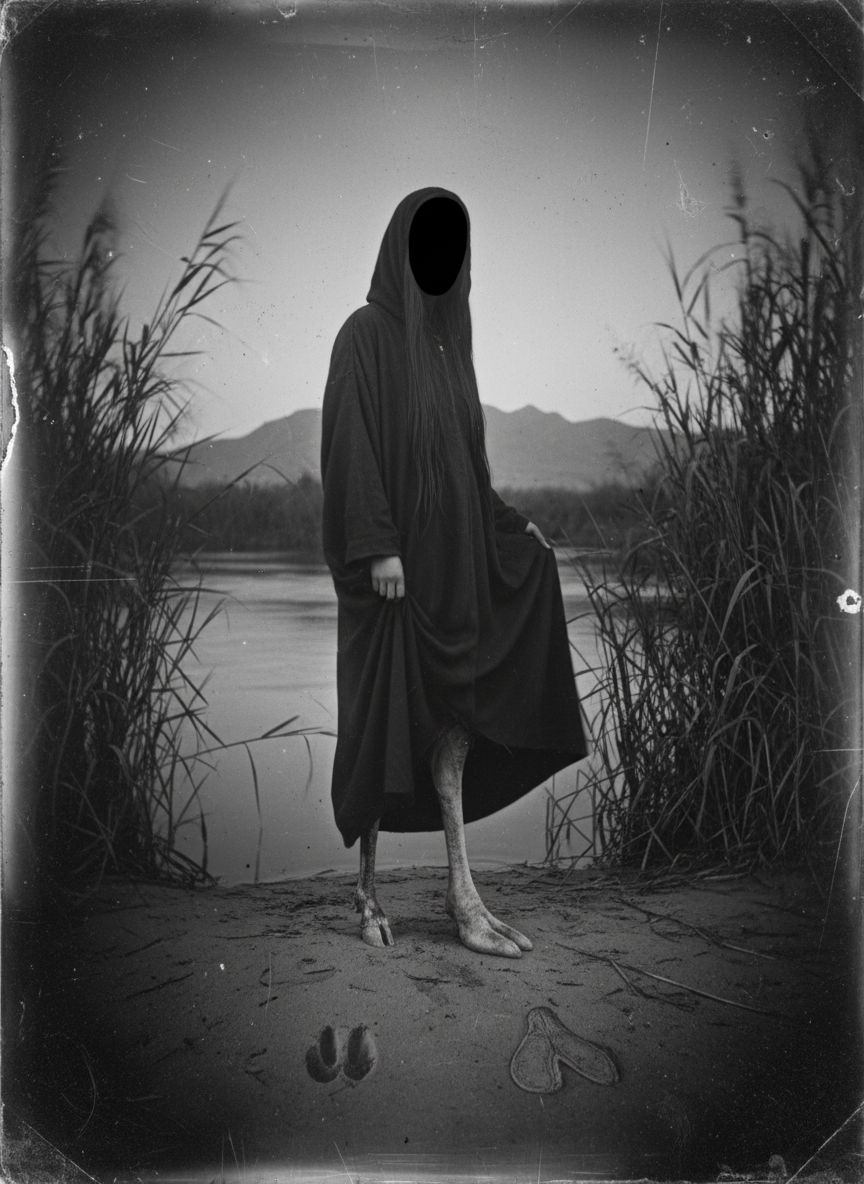
She stepped out of the cane. The records describe her as tall. The cloak was dark. The face beneath the cloak was the face of a young woman, beautiful in the way the records call dangerously beautiful, the eyes lined, the mouth red, the hair long and uncovered. She did not speak to him. She walked. The wind from the river lifted the hem of the djellaba.
One leg was a camel’s. One was a goat’s.
The records emphasise this. The hooves had been hidden by the cane. She had stepped out onto the wet sand of the bank on those legs, and Tuhami had not seen them, because he had been looking at her face. He saw them only when the hem lifted. The accounts that Westermarck recorded from the villages of the Zerhoun describe variants: sometimes one leg is a donkey’s, sometimes both are a camel’s, sometimes the legs are human but reversed at the knee. The constant is the moment of seeing. The man sees the legs after he has already looked too long at the face.
From that moment, the records say, she is in him.
On the marriage
She came in the dreams.
Tuhami described to Crapanzano the nights after the river. He had returned to Meknes. He had said nothing. Within the week she was visiting him in sleep. She did not change her form. She did not speak. She sat at the edge of the sleeping mat and she watched. By the second week she had begun to lie down beside him. By the third week she had begun to lie upon his chest.
The records of the Hamadsha tradition are consistent in the language used for what followed. The man does not contract a possession. The man contracts a marriage. Aisha Qandisha takes a husband. The husband must observe certain prohibitions for the duration of the marriage, which is the duration of his life. He must not marry a human woman, because if he does, the spirit sits on his chest at night until he wakes choking, and she will not permit the human marriage to be consummated, and the human wife will not remain. He must not wear the colours she has forbidden. He must keep iron on his person, an iron knife or an iron nail, at all times.
He must, once a year, attend the shrine of her saint.
On the rite at Sidi Ali
The shrine is at Sidi Ali ben Hamdouch, at the foot of the Zerhoun massif, an hour’s walk above Meknes.
The Hamadsha brotherhood gathered there for the moussem in the season. The records of Westermarck describe what Crapanzano confirmed half a century later. The men possessed by Aisha Qandisha came to the shrine to renew the contract. The brotherhood performed the hadra, the trance in which the drummers played the rhythms specific to the spirit, and in which the possessed danced, and in which a portion of the men cut themselves across the scalp with knives or with the heads of axes, because the spirit asked for blood and the blood of the head was the blood she could be paid in.
A black goat was sacrificed at the courtyard of the shrine. The throat was cut over a copper basin. The blood was poured at the threshold of the saint’s tomb. The men who had come to renew the marriage drank from the basin or were marked on the forehead with the blood. The trance closed. The contract was renewed for another year.
Tuhami went to Sidi Ali every year. He paid the goat. He cut the scalp. He kept the iron in his pocket. He did not marry a human woman.
The archive holds no position on whether Aisha Qandisha was at the river that day. The archive observes only that Tuhami had washed there, that the cane had been thick, that the voice had been a woman’s, that the hem of the djellaba had lifted, and that the rest of his life had been arranged around the shrine at the foot of the Zerhoun.
- Westermarck, Edward. Ritual and Belief in Morocco. London: Macmillan, 1926. Volume I. The first systematic ethnographic record of *Aisha Qandisha* and her relations with the Hamadsha brotherhood.
- Crapanzano, Vincent. Tuhami: Portrait of a Moroccan. Chicago: University of Chicago Press, 1980. The case history of an illiterate tilemaker of Meknes married to *Aisha Qandisha* across two decades.