The Painted Skin
China (Taiyuan, Shanxi province) · Qing, recorded by Pu Songling c. 1679
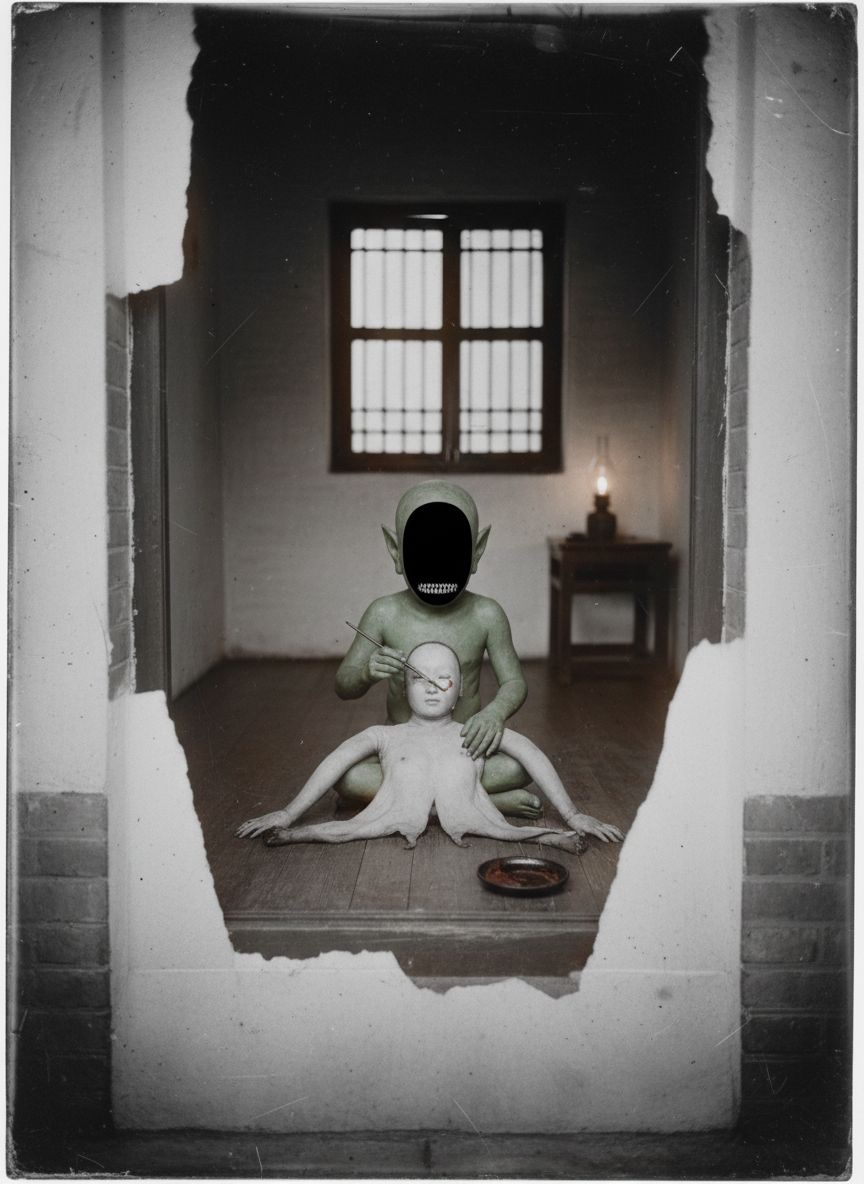
The scholar’s name was Wang. The records give him no other. He was a man of Taiyuan, in the northern province of Shanxi, a holder of the first degree, and was returning to his house on a morning of the early autumn when he overtook a young woman on the road. The woman was carrying a small bundle and was alone. She was, the records say, sixteen years of age, and beautiful, and unwilling to give the name of the household she had come from.
Wang took her in.
He gave her the small inner room of his study, at the back of the courtyard, with the window of paper that opened upon the inner garden. He did not tell his wife. He visited the room at night and returned to his own bed before the household woke. The arrangement held for a week. The records say the scholar grew thin in this week, and that the colour left his face, and that he did not eat at the family table, and that the wife, who was patient, kept her own counsel.
On the eighth day the scholar came home before the hour at which he was expected.
He found the door of the inner room barred from within. He went around to the garden. The window of paper had been torn at the lower edge. He looked through.
On what was at the window
The records of Pu Songling, who wrote the tale down in the studio he kept at Zichuan in Shandong in the years around 1679, are exact about what the scholar saw.
A creature was seated upon the floor of the room. The creature was the green of old jade and was the size of a child. The teeth were the teeth of a saw, set in two long rows. The eyes were red. The brow was heavy. The hands were the hands of a man, but were narrow, and had nails the colour of soot, and were occupied. Across the knees of the creature a human skin was spread. The skin was a woman’s skin. The skin was complete from the crown of the head to the heels of the feet, and had been split at the back along the spine and laid flat, as a tanner spreads a hide. The creature held a fine brush of horsehair in its right hand and was painting, with a delicate motion, the eyes back onto the face.
The skin was spread upon the knees. The brush moved across the face. The girl he had known for a week was not yet inside it.
The records say the scholar did not cry out. The records say he stood at the window until the creature had finished the eyes, and the brows, and the small red mark at the centre of the lower lip, and had shaken out the skin once, sharply, in the manner in which a cloth is shaken, and had thrown the skin across its own shoulders. The records say that the girl Wang had taken in stood up at the centre of the room and walked to the window and pulled the paper closed.
On the rite that followed
Wang fled to the priest at the Taoist temple on the western hill. The priest, an old man whose name the tale does not record, was unwilling to intervene. He gave the scholar a small whisk of horsehair and told him to hang it from the door of the room.
The girl returned that night. She broke the whisk against the lintel. She entered the inner room. She came across the courtyard to the bedchamber of the scholar’s house. She tore the heart from the chest of Wang and carried it out with her in her hand.
The wife of Wang went at first light to the temple on the western hill and would not let the priest refuse. The priest came down with her. The priest tracked the creature to a small low house at the edge of the city in which a beggar woman had been taken in by a charitable household. The priest struck once with his wooden sword. The skin fell. The body within was the green creature of the inner room, the teeth still bared, the brush still held. The priest beheaded it. The skin was burnt in the courtyard. The smoke rose without bending in the still autumn air.
On what was buried
The wife of Wang carried the body of her husband home and prepared the heart, by the means the priest had given her, and the scholar was restored to her, in a manner the tale describes but the archive will not paraphrase.
The archive holds no position on the means by which the skin was made, or on the means by which the scholar was returned. The archive observes only that the scholar of Taiyuan had taken a girl in at the gate of his house, and that the door of the inner room had been barred from within, and that the window of paper had been torn, and that the brush had been moving across the face when the husband looked through.
- Pu Songling. Liaozhai Zhiyi [Strange Tales from a Chinese Studio], volume 1, tale 40, Hua Pi. Composed in Zichuan, Shandong, c. 1679. Standard punctuated edition: Zhonghua Shuju, Beijing, 1962.
- Giles, Herbert A. Strange Stories from a Chinese Studio. London: Thomas De La Rue, 1880. The first English translation of the Liaozhai tales, with the Painted Skin given in full in volume one.
- Zeitlin, Judith T. Historian of the Strange: Pu Songling and the Chinese Classical Tale. Stanford: Stanford University Press, 1993. The standard scholarly study of the Liaozhai and its conventions of testimony.