The Grootslang at the Wonder Hole
South Africa (the Richtersveld, the Orange River below Augrabies Falls) · Early twentieth century, the prospector record of 1910
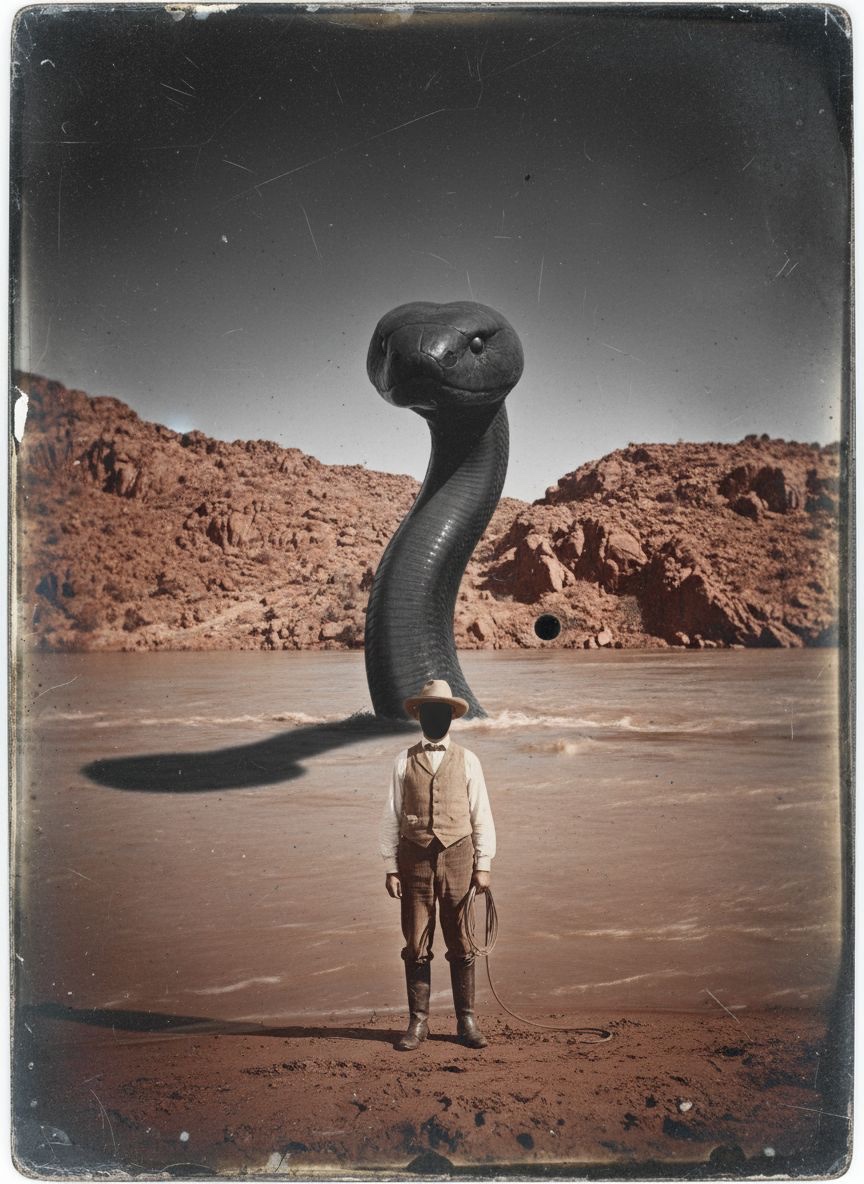
The case was recorded by Frederick Carruthers Cornell in The Glamour of Prospecting, published by Fisher Unwin in 1920. The witness was not Cornell. The witness was a man Cornell names as Kammeyer, his companion on a prospecting trip into the Richtersveld in the early months of 1910. The river was the Orange. The reach was twenty miles below the Augrabies Falls.
The Khoikhoi guides knew the reach by a single name. They called it the Wonder Hole. They would not approach the sinkhole that gave the reach its name. They would not water the cattle there. They had warned Cornell and Kammeyer at the previous camp.
Kammeyer had gone alone to the bank.
On the sighting
The river was in flood.
Cornell’s record places the day at the close of the summer rains. The Orange had risen above the rocks of the lower channel and filled the pools below the falls to the height of the lower terraces. The Wonder Hole, in the dry season a circular sinkhole twenty feet across at the edge of the riverbed, was at this season submerged, the opening invisible beneath the brown water.
Kammeyer had taken a yearling calf to the bank to drink. The calf belonged to one of the Khoikhoi families travelling with the prospectors. He led it down the slope to the wet sand at the edge of the flood. The calf put its head to the water.
Kammeyer did not see the rise.
He saw the calf. Then he saw the water in the place where the calf had been. The bank was empty. There had been no sound. There had been no struggle. There had been, Cornell records Kammeyer reporting, a movement at the edge of his vision, a movement so large he had not understood it as a movement at the moment it had occurred. He looked up.
The serpent was above him.
The records give the height as twelve feet from the surface of the water to the top of the head. The thickness was the thickness of a man’s chest. The colour, in the late afternoon light, was the colour of the wet mud of the flood, brown going to black at the back, paler at the throat. The eyes were small for the head and were set forward. The head was not the head of a python or a cobra. The head, Kammeyer told Cornell, was the head of nothing he had ever seen, and the head was watching him.
Kammeyer did not move.
The serpent did not strike. It held the position for what Kammeyer estimated at three or four seconds. It then sank, vertically, into the water of the Wonder Hole. The surface closed. The flood ran on as before.
The calf was not recovered.
On the Wonder Hole
The Wonder Hole was the entrance.
The Khoikhoi guides, when Kammeyer returned to camp, did not express disbelief. They said the Grootslang, the great snake, lived in the Wonder Hole, that the sinkhole opened into a cavern that ran under the riverbed and beyond, and that no one had ever measured the depth. They said the Grootslang was older than the country. It took cattle at the bank in the flood season. It took men also. The bodies were not recovered because the cavern was very deep.
The older guide, an Nama elder Cornell does not name, told them what the country to the north had said about the Grootslang in the time before the first farmers had come. It had been made wrong. The maker, in the first making, had not split it properly into the elephant and the snake; the elephant had been given the body and the snake had been given the body and the Grootslang had been left over, with the head of the one and the length of the other, and it had been put into the cavern beneath the Wonder Hole because it could not be put anywhere else.
Cornell did not believe the elder. Cornell recorded what the elder said.
On the next morning
The Khoikhoi broke camp at first light.
Cornell records that Kammeyer did not speak of the encounter again for the remainder of the trip. He did not return to the bank. The party did not approach the Wonder Hole on the return. Cornell, writing the case up ten years later, set it down as Kammeyer had given it, without embellishment, and added that the Khoikhoi had refused all subsequent attempts by the prospecting parties of the next two seasons to lead them to the sinkhole.
Green, writing in 1945 from a generation of further Richtersveld report, confirmed that the Wonder Hole had remained unapproached. The opening itself, in the dry seasons of the 1930s, was visible at the bank, a perfect circle in the red rock, the water inside it standing dark and still and at a level the flood could not account for.
The archive holds no position on whether the Wonder Hole opens into anything at all. The archive observes only that Kammeyer had taken a calf to the bank in the flood of 1910, and that the bank had been empty when he looked back, and that the head that had risen above the water had been the head of nothing he could name, and that he had not returned to the river.
- Cornell, Frederick Carruthers. The Glamour of Prospecting: Wanderings of a South African Prospector in Search of Copper, Gold, Emeralds, and Diamonds. London: T. Fisher Unwin, 1920. Project Gutenberg #70674. The first-hand record of the Kammeyer encounter on the Orange River.
- Green, Lawrence George. Where Men Still Dream. Cape Town: Howard Timmins, 1945. The mid-century compilation of Richtersveld and Namaqualand prospector lore, including the *Grootslang* tradition at the Wonder Hole.