The Heart at Marotinu de Sus
Romania (Marotinu de Sus, Dolj County, Oltenia) · Modern, the winter of 2003 to 2004
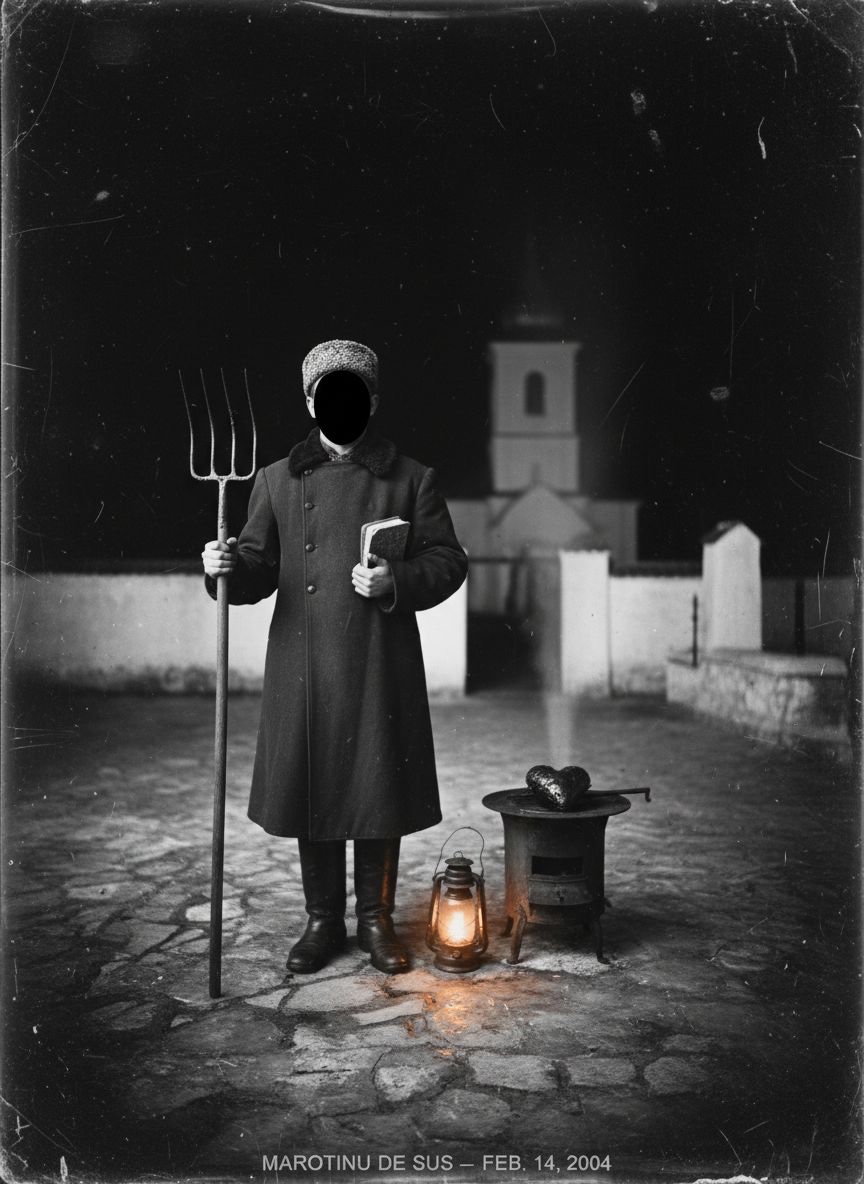
The schoolteacher Toma Petre had been a quiet man. The records of the Marotinu de Sus parish list him as fifty-five years old at the time of his death, unmarried, resident in the second house on the road that ran east from the church towards the Jiu. He had been the village teacher for thirty-one years. He had taught the children of his sister, and the children of those children, and he had been buried in the small cemetery behind the church on a Saturday in December 2003. The funeral was attended by most of the village. The ground was hard and the grave had been dug the day before.
Within the month his niece began to dream.
The dreams were specific. She was twenty-three years old, the wife of a labourer who worked the fields outside Craiova in the summer and the slaughterhouse at Bechet in the winter. She reported, first to her mother and then to the elder women of the village, that her uncle was coming to her at the hour between three and four in the morning, that he sat on the edge of the bed and pressed his hand against her chest, and that the pressure left a coldness in her that did not leave by morning. She began to cough. She lost weight. The elder women of the village, in the way the elder women of Marotinu de Sus had handled this for as long as anyone could remember, called the men.
On the rite the village performed
The men went to the cemetery on the night of the fourteenth of February.
The record of the rite is held in the indictment of the Dolj County tribunal, in the testimony the six men gave to the magistrate at Craiova six weeks afterwards, and in the reporting of the foreign correspondent who travelled to Marotinu de Sus in the spring. The men were six. The eldest was the brother-in-law of the niece. They carried a kerosene lantern, two spades, a pitchfork of the kind used in the village for hay, a small iron stove of the kind used by the shepherds on the long pastures, and a flask of țuică that the brother-in-law had distilled the autumn before. They went after sundown because the rite required it.
They dug for two hours. The ground had frozen and then thawed and then frozen again, and the grave was harder to open than it had been to close in December. They lifted the coffin. They struck the lid with the back of the spade. They prised the lid free.
The schoolteacher had not turned. The brother-in-law later testified to the magistrate that the body was as it had been laid down, the suit intact, the face slack but not collapsed, the hands folded as the village women had folded them in December. He testified that he set the pitchfork against the sternum. He testified that he leaned his weight upon it. He testified that the ribs gave with a sound he could not afterwards describe and that, as the tines passed through, the body released a long breath that the six men present agreed at the time was a sigh.
They took out the heart.
On the heart and the well
The heart was carried in a tin pail to the small iron stove the men had set down on the consecrated ground of the cemetery courtyard.
The stove was lit. The heart was placed upon it. The men stood at the perimeter while it burned, the brother-in-law reading from a small printed book the priest of the parish had not given him. The burning took some hours. The men gathered the ash into the tin pail when the iron of the stove had cooled. The ash was carried, still in the pail, to the well of the family of the niece. The water of the well was drawn into a glass. The ash was stirred into the water. The glass was carried into the house. The niece drank it in one swallow at the kitchen table at the hour before dawn.
By the next afternoon the coldness in her chest had gone. By the end of the week the cough had stopped. The niece, in her own testimony to the magistrate, said only that her uncle had not come back to her bedside after that night and that she had begun, for the first time in two months, to eat.
On the prosecution
The brother-in-law was prosecuted under article 319 of the Romanian Penal Code, the disturbance of human remains. He was convicted. He served six months. The five other men received suspended sentences. The body of the schoolteacher was reburied without the heart in the same grave in the same cemetery. The village did not, in the testimony recorded that spring, dispute the conviction. The brother-in-law said only that he had done what the village had always done in such a case, that the niece was alive, and that the magistrate had not been there.
The archive holds no position on whether the schoolteacher had returned to the bedside of his niece in the small hours of the new year. The archive observes only that the village had a procedure, that the procedure was performed in February 2004 with a hay pitchfork and an iron stove and the well of the family, that the body had not turned in two months in cold ground, that the niece drank the ash and recovered, that the magistrate prosecuted, and that the rite, in Marotinu de Sus, was not the first the village had performed and was not understood to be the last.
- Perrottet, Tony. "Transylvania's Vampire Hunters." *Smithsonian Magazine*, January 2005. First-hand reporting from Marotinu de Sus six weeks after the exhumation, with named villagers and the magistrate of the Dolj County tribunal.
- Cremene, Adrien. *La mythologie du vampire en Roumanie*. Monaco: Éditions du Rocher, 1981. The standard French ethnographic survey of the *strigoi* tradition across Oltenia, Wallachia, and Transylvania.
- Hedeșan, Otilia. *Pentru o mitologie difuză*. Timișoara: Marineasa, 2000. The principal Romanian academic treatment of the persistence of *strigoi viu* and *strigoi mort* beliefs into the post-communist period.