The Penanggalan
Malaya (Selangor, the Kuala Langat district) · Late colonial, recorded by W. W. Skeat 1897 to 1899
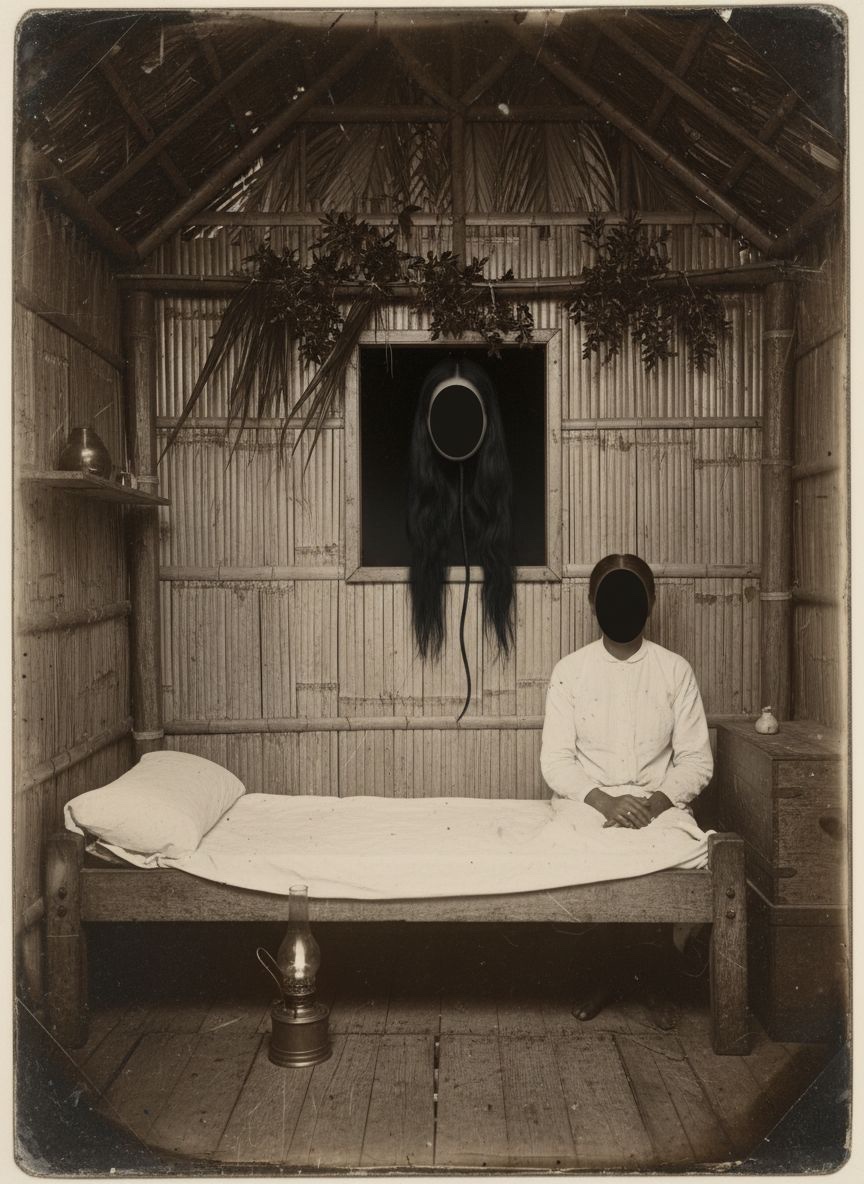
The case was recorded in the district of Kuala Langat, in the state of Selangor, in the closing years of the nineteenth century. The witness was a midwife of the kampung. The setting was a birthing-room in a stilt-house of bamboo and attap. The night was without moon.
The midwife heard the dragging first.
She described it later to the colonial folklorist as the sound of wet cloth pulled across the dry palm of the roof. The pregnant woman, in her labour, had not heard it. The midwife had heard it because the midwife had been told to listen. The older women of the kampung had warned her. The fortieth day after a birth was the most dangerous, but the night of the birth itself was the night the penanggalan came closest. They had told her what to listen for and they had told her what to hang.
She had not hung enough.
On the thing at the window
The head lowered itself at the window.
The records of W. W. Skeat, who collected the midwife’s account and the accounts of three other women of the district within the same season, agree on the order of the description. The hair came first, hanging the wrong way, long, parting at the sill. Then the face, inverted, the eyes open. Then the neck, ragged at the stump, and below the stump the entrails, intact, the stomach and the liver and the long coil of the small intestine, swinging beneath the jaw like a lantern made of meat.
The body of the penanggalan was not at the window. The body of the penanggalan was elsewhere. By day, Skeat recorded, she lived as a woman of the village. By night her head detached at the neck and flew, the organs trailing wet beneath it, in search of the houses where women were in labour or in the lying-in period that followed.
She did not enter through the door. She did not enter at all. The tongue, the records say, was the thing that entered. The tongue was invisible, or nearly so, and it could thread through the small gaps between the boards of the floor, and it sought the body of the mother, and what it drew from her was the blood of childbirth.
On the rite of the jeruju
The counter-rite was the hanging of thorns.
Skeat recorded it carefully, as did Endicott seventy years later from informants in the same belt of villages. The thorn of choice was jeruju, the sea-holly, whose leaves bore sharp recurved spines. Branches of jeruju were hung at every entrance to the birthing-room: at the door, at the window, around the sleeping platform of the woman, beneath the floorboards through which the tongue might come. With the jeruju was hung mengkuang, the pandanus, whose long blades served the same purpose.
The mechanism was specific. The midwife did not need to see the penanggalan. The trailing entrails would catch on the thorns. The head, returning before dawn to rejoin the body it had left elsewhere in the village, would snag, would struggle, would be unable to free itself. By daybreak the body, abandoned in some other house, would be cold. The head, by the same hour, would be hanging in the open at the window of the birthing-room for the whole kampung to see.
The body of the witch was named, in the records, by the face. The face was known. The face had been a neighbour.
On the midwife’s account
The midwife of Kuala Langat did not hang the jeruju in time. She had brought a small bundle. She had hung it at the door. She had not hung it at the window, because the window had been small, and she had judged the gap too narrow for a head to enter, and she had been wrong about the width of a head when the neck no longer held it.
The mother lived. The child did not. The midwife, in her statement to Skeat through an interpreter, was clear on the order: the child had died first, before the morning, while the dragging on the roof had continued. The mother had bled for three days afterwards, and had recovered, and had not borne again.
The midwife said that she had seen the face at the window for not more than the count of one breath. She had not given the name. Skeat noted in the margin that the interpreter had pressed and that she had not given it and that she would not, even for the colonial record, name the woman whose head she had seen.
The archive holds no position on whether the head returned to its body. The archive observes only that the midwife had been warned, and that the thorns had been few, and that the child had been buried that morning at the edge of the rice land, and that the midwife, after the season, did not attend a birth in that district again.
- Skeat, Walter William. Malay Magic: Being an Introduction to the Folklore and Popular Religion of the Malay Peninsula. London: Macmillan, 1900. The Selangor field record, pp. 326 and accompanying plate.
- Endicott, Kirk Michael. An Analysis of Malay Magic. Oxford: Clarendon Press, 1970. Chapter 3 on the inventory of Malay spirit-beings and the *penanggalan* in particular.