The Spirit in the Champac Tree
Burma (Tagaung, Upper Burma; later Mount Popa) · The Pagan dynasty, the eleventh century
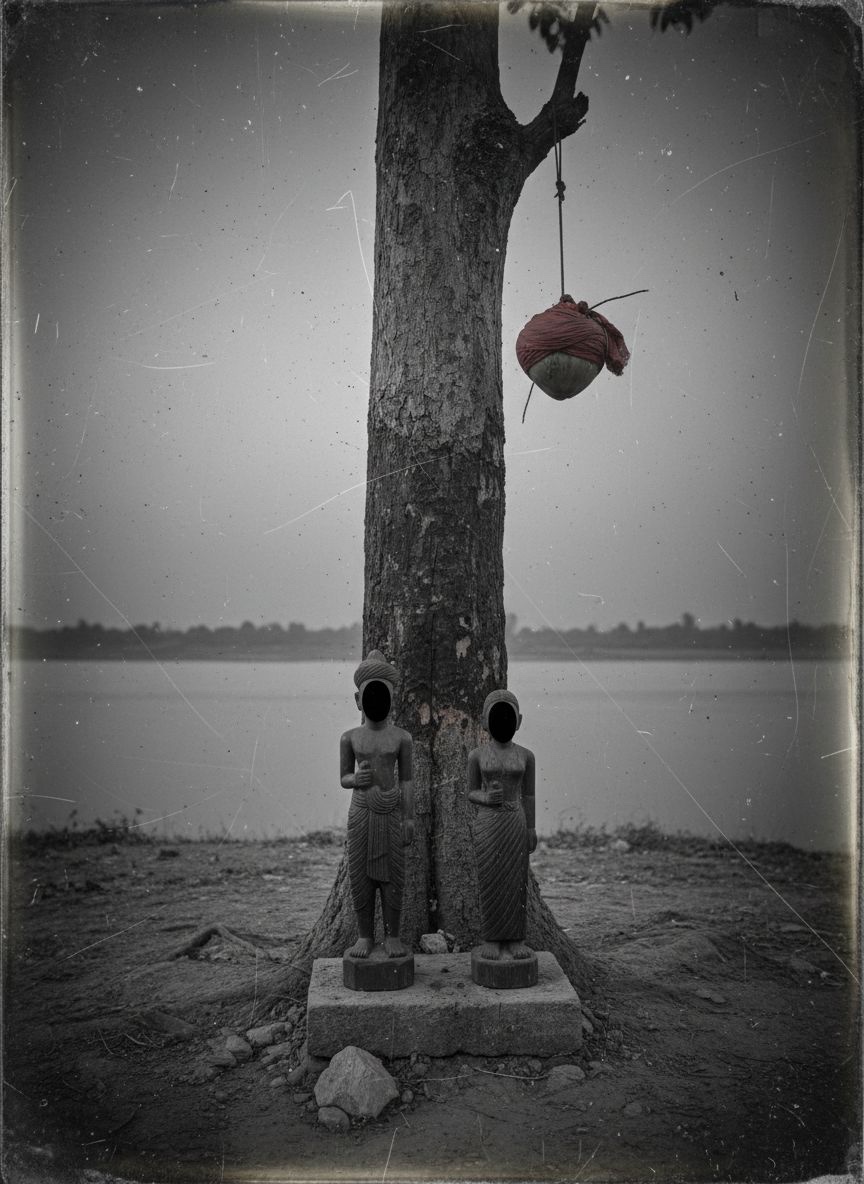
The records of the Burmese chronicles, the Hmannan Yazawin of the Konbaung court and the older Maha Yazawin before it, place the case at Tagaung on the upper Ayeyarwady in the years before the founding of Pagan. The names are given. The blacksmith of Tagaung was called Maung Tint De. His sister was Shwe Myet Hna, the Lady of the Golden Face. He was a man of unusual strength. The chronicles say that he could break iron bars across his knee and could lift a beam that took four men to set down. The king of Tagaung, whose name in the older chronicles is Thinligyaung, feared the blacksmith and what could be raised in his name.
The king did not summon the blacksmith to the court. The king summoned the sister.
The sister was taken into the palace as a consort. The court treated her as a queen. The king sent word, in her name, to the brother. The brother was invited to the capital to attend the consecration of his sister as the king’s wife. The brother came down from the smithy at the edge of the town, in clean clothes, unarmed, with the small ceremonial dagger of a brother attending a sister’s marriage.
He was met at the gate. He was bound. He was carried to the champac tree at the river-bank below the palace. He was lashed to the trunk.
On the burning
The chronicles agree on the order of the burning.
The dry brush had been heaped at the foot of the tree before the brother arrived. The fire was lit at the moment he was made fast to the trunk. The flame climbed the dry bark of the champac. The blacksmith did not call out at the first. He called out when the smoke entered his throat. The sister, who had been kept in the upper room of the palace and had not been told, heard the calling. She broke from the women of the chamber. She ran down through the courtyards and through the river gate and out onto the bank of the Ayeyarwady. The chronicles say the king’s men stood aside. The chronicles say the sister did not slow at the edge of the fire. The chronicles say she threw herself onto the burning brush at the foot of the tree and held the trunk with her arms until the heat had taken her.
The two were not removed from the tree.
The chronicles say the tree, when the fire had burned out, still held them. The trunk was charred to the level of the lower branches. The bodies were charred against the trunk. The villagers came down at dusk to see. The villagers who walked beneath the champac tree on that bank were found in the morning with their throats opened, bodies dry.
On the felling and the carving
The king ordered the tree felled.
The chronicles say the king sent the elephants of the royal compound to drag the trunk into the river. The trunk was dragged. The trunk floated. The trunk turned in the current and would not move downstream. The chronicles say the trunk was retrieved at the bend below the palace and was hauled out and was set in the courtyard of the king’s house and was given to the woodcarvers of the court. The carvers were told to take the faces of the brother and the sister from the wood.
The two faces were carved.
The faces were the faces of a man and a woman. The wood, the chronicles say, took the carving without resistance. The two faces were set on a pillar at the eastern gate of the city. The disturbances at the river-bank ceased.
On what was buried
The relocation of the cult is the work of Anawrahta, the founder of the Pagan dynasty, in the middle of the eleventh century. Anawrahta removed the faces from the gate at Tagaung and carried them to Mount Popa, the volcanic neck north of Pagan, and there installed them at the summit. The brother and the sister are the second and the third of the canonical thirty-seven nats. They are not separated in any rite.
The tribute, in the household form recorded by Spiro in his fieldwork of 1959 to 1961, is given at the southeast post of the traditional Burmese house. An unhusked green coconut is wrapped in a red turban and hung from the post. The post is called the ein-dwin nat post and is, in the older houses of the dry zone, set in the ground before the house is raised.
The archive holds no position on whether the brother and the sister of Tagaung continue, in the tree at the river-bank, to attend to those who pass beneath. The archive observes only that the chronicles record the burning, and that the villagers were found in the morning with their throats opened, and that the tree was felled, and that the faces were carved, and that the coconut is, in the houses of the dry zone, still hung from the southeast post.
- Temple, Richard Carnac. The Thirty-Seven Nats: A Phase of Spirit-Worship Prevailing in Burma. London: W. Griggs, 1906. The standard colonial-period catalogue of the Burmese nat pantheon, with the Mahagiri brother and sister entered as the second and third of the canonical thirty-seven.
- Spiro, Melford E. Burmese Supernaturalism: A Study in the Explanation and Reduction of Suffering. Englewood Cliffs: Prentice-Hall, 1967. Chapter four treats the household cult of the ein-dwin nat and the coconut tribute.
- Maung Htin Aung. Folk Elements in Burmese Buddhism. London: Oxford University Press, 1962. The Burmese-language account of the Tagaung incident and the relocation of the cult to Mount Popa by King Anawrahta in the mid-eleventh century.